Leased line replacement has been a growing priority for organizations managing critical communications infrastructure. Recent regulatory changes have accelerated this shift, turning what was once a long-term consideration into an immediate operational concern.
A Regulatory Shift Is Forcing Immediate Action
In March 2026, the Federal Communications Commission (FCC) adopted its Network and Services Modernization Order (WC Docket Nos. 25-208, 25-209), accelerating the retirement of legacy copper infrastructure and removing barriers that once slowed the transition to IP networks.
While the FCC maintains that essential communications will remain protected, the practical reality is clear: organizations relying on leased lines and POTS must now transition on a defined timeline—or risk service disruption. This is particularly true for organizations using ring-down phones, analog two-way radio, and SCADA, for example, as there is no legislative protection for these services.
For public safety agencies, utilities, transportation systems, and municipalities, the impact is immediate. Critical applications such as SCADA, fire alarms, radio communications, and emergency call systems often still depend on DS0 private line connectivity. As carriers phase out copper, these systems can no longer rely on legacy infrastructure.
With approval requirements reduced and local regulatory intervention limited, the responsibility to act has shifted to the end user. In many cases, organizations may have as little as 60 days to respond.
The End of Legacy Assumptions
Leased lines have long been trusted for their reliability and predictability. But that reliability was tied to infrastructure that is now being actively decommissioned.
This creates a new risk environment:
- Connectivity is no longer guaranteed
- Replacement timelines are externally driven
- Delays will directly impact mission-critical operations
- Complete infrastructure replacement is costly and capital-intensive
At the same time, the transition supports broader initiatives such as Next Generation 911 (NG911), which depend on flexible, IP-based networks. The question is no longer whether to migrate, but how to do so without disruption.
Modern Networks, Existing Systems
IP-based infrastructure offers clear advantages, including scalability, redundancy, and centralized management. But for organizations with legacy systems, migration introduces real complexity.
Replacing leased lines requires more than new bandwidth. It demands:
- Seamless support for legacy interfaces
- Low, predictable latency for real-time traffic
- High reliability with built-in redundancy
- Compatibility across fiber and cellular networks, including FirstNet Authority and Frontline
For many organizations, a full system replacement is neither practical nor necessary. In such cases, the best type of solution is often to find a way to bridge legacy systems into modern networks.
Bringing Legacy over IP with TC Communications
TC Communications addresses this challenge with purpose-built solutions for leased line replacement.
At the center is the JumboSwitch® platform, which enables organizations to transport serial, analog, and TDM traffic over Ethernet and IP networks—without requiring changes to existing field equipment.
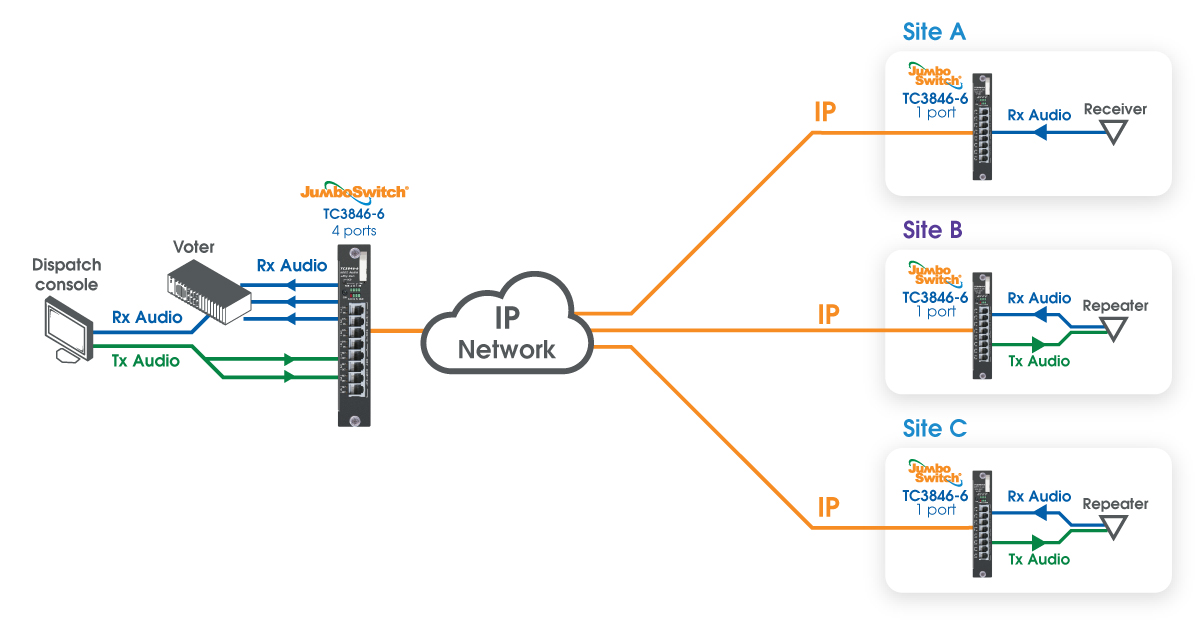
Connecting devices over existing IP/MPLS network using JumboSwitch's Multi-Service interface cards
This approach allows legacy systems to function as if they are still connected via dedicated circuits, while operating over modern infrastructure.
Key capabilities include:
- Protocol transparency for legacy equipment
- Low-latency transport for real-time applications
- Network flexibility for IP and cellular networks, including FirstNet Authority and Frontline
- High availability, with redundancy and failover
- Phased migration support, reducing operational risk
Rather than forcing immediate replacement, TC enables organizations to modernize incrementally—preserving existing investments while upgrading the underlying network.
A Circuit-Based Alternative: T1 with Mini Channel Bank and JumboBank
While IP-based migration offers flexibility and scalability, some applications require a more predictable, circuit-based approach. For these environments, T1/E1 services remain a viable alternative where available.
TC Communications supports this approach with both Mini Channel Bank and JumboBank™ solutions—two complementary platforms designed for T1-based leased line replacement.
The Mini Channel Bank provides a simple plug-and-play option for lower channel-count applications. As a hardware-only solution, it requires no firmware updates or complex configuration, making it ideal for environments where simplicity and stability are critical. It enables organizations to preserve existing equipment and transport legacy interfaces over T1/E1 with minimal effort.
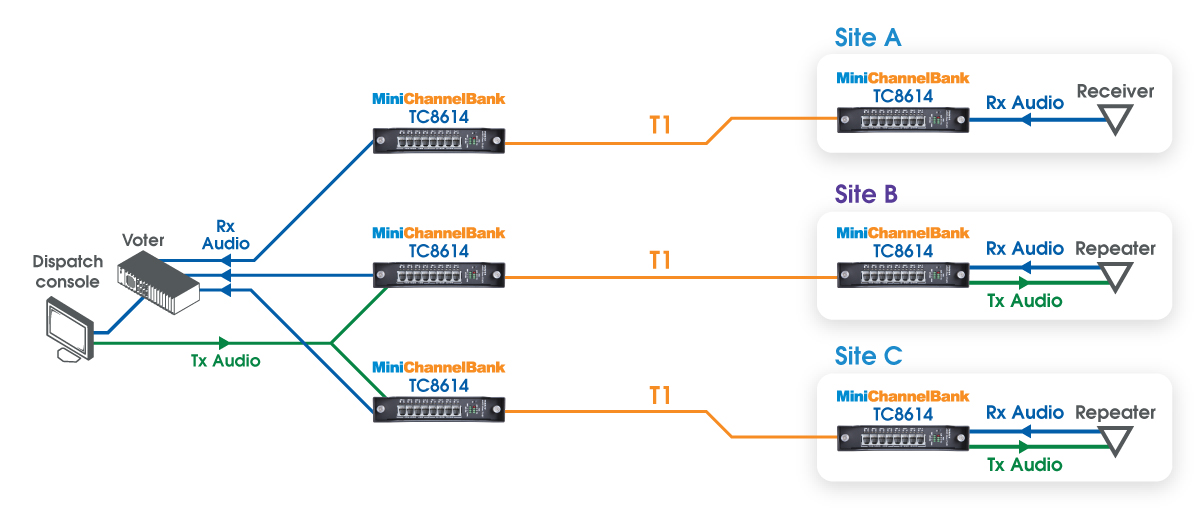
Replacing leased lines utilizing existing T1 circuits
For higher-density or more complex systems, the JumboBank extends this capability. Designed as a modern channel bank replacement, it supports multiple interface cards and can transport a wide range of legacy signals over single or multiple T1/E1 lines, with options for redundancy.
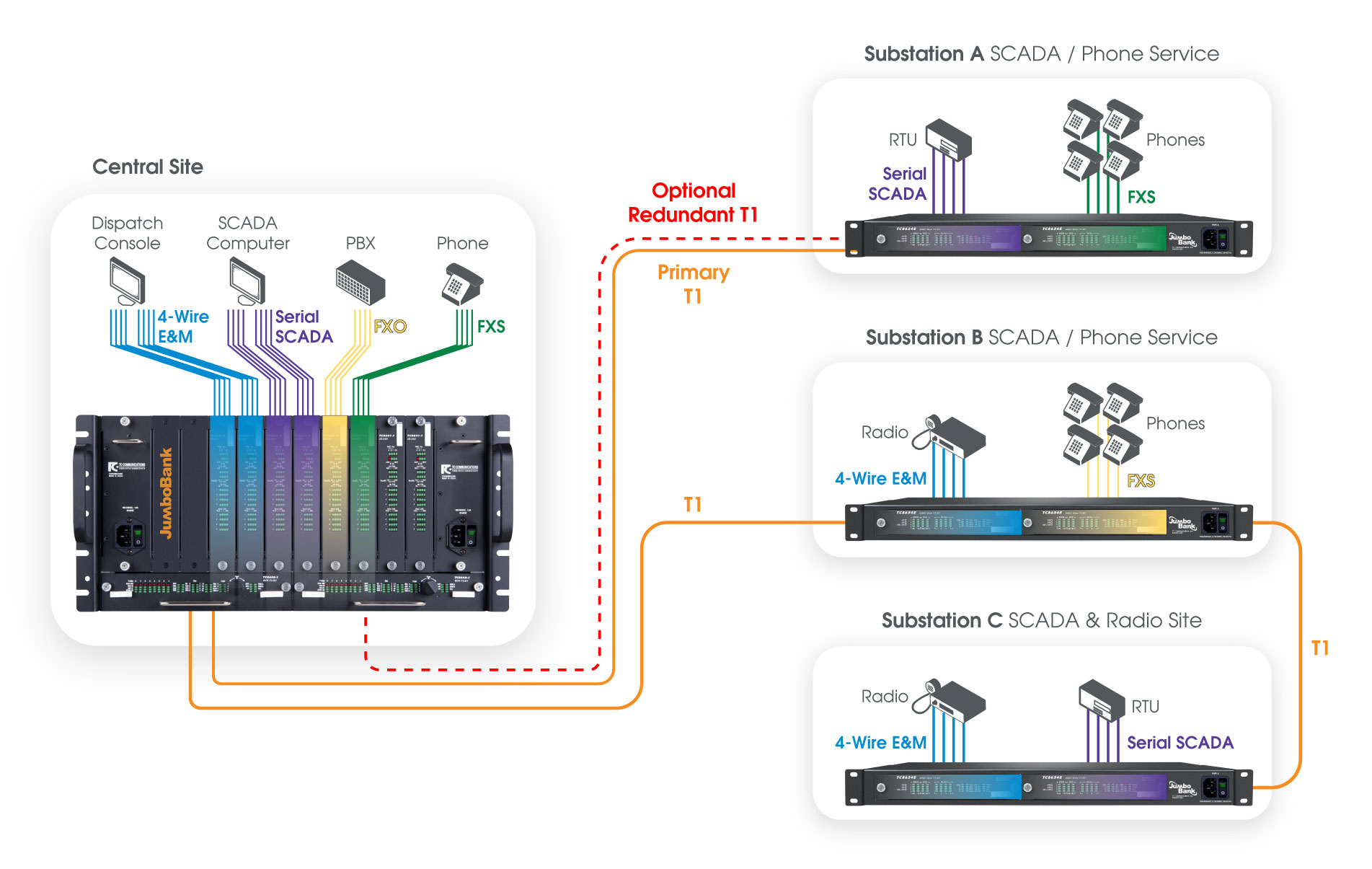
Combining multiple interfaces over single or multiple T1/E1 lines
Together, these T1/E1 solutions provide:
- Extremely low latency with consistent, deterministic performance
- High voice quality for analog applications
- Seamless integration with existing systems
Because these are circuit-based, hardware-driven solutions, they also avoid the need for traffic prioritization or ongoing cybersecurity management typically associated with packet-based networks.
In real-world deployments, organizations have used this architecture to maintain legacy equipment, such as radio voters and receivers, while transitioning away from copper leased lines.
For applications where simplicity or existing T1 infrastructure are priorities, Mini Channel Bank and JumboBank offer a practical and reliable migration path.
Proven in the Field
While the recent surge in leased line replacement is already underway across multiple industries, for the past 10 years, TC Communications has been at the forefront of helping organizations transition to modern, secure networks, with measurable results.
Public safety agencies, for example, have successfully transitioned from leased line backhaul to IP-based networks using JumboSwitch, maintaining mission-critical reliability while improving scalability and reducing costs.
In one such deployment, a county fire network replaced its leased line infrastructure with a modern IP solution using the TC3846-6 E&M and Dry Contact over IP Gateway, enabling greater flexibility and long-term cost savings without compromising performance. More than 18 months later, the network had not experienced a single fault.
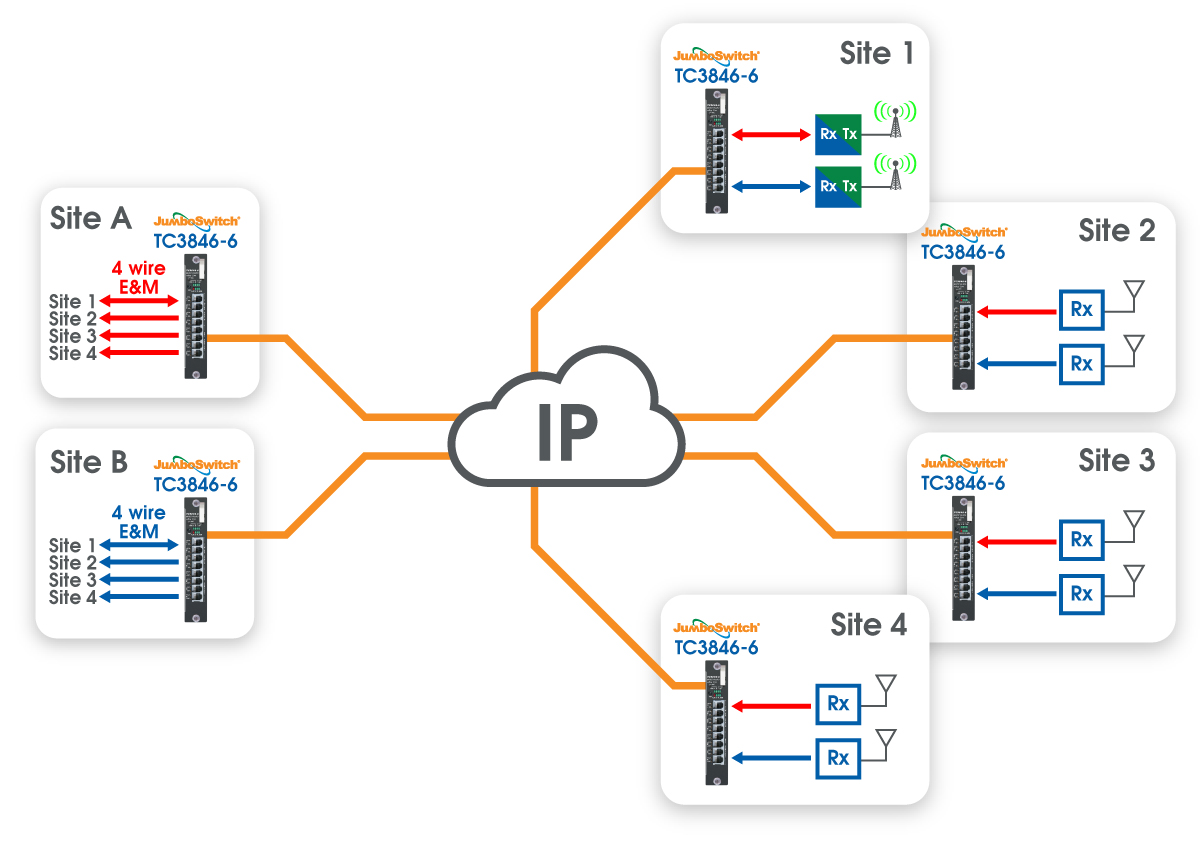
Learn more by reading the full case study.
Additional deployments have demonstrated that organizations can significantly reduce recurring leased line expenses while gaining access to modern capabilities such as centralized management and expanded network reach. Though TC Communications has been involved in such projects for several years, there remains a lot of work to be done.
What Organizations Can Do Next
With timelines compressed and risks increasing, organizations should take a structured approach:
- Identify leased line dependencies across all systems.
- Prioritize critical applications that require immediate attention.
- Deploy bridging solutions to enable IP transport without disruption.
- Migrate in phases, minimizing downtime and risk.
- Plan for long-term scalability and future integration.
This approach allows organizations to respond quickly to regulatory changes while building a more resilient communications infrastructure.
Turning Urgency into Opportunity
The retirement of leased lines is no longer a distant concern—it is happening now. Organizations that delay risk operational disruption, while those that act can modernize their networks and reduce long-term costs.
With proven technology and real-world deployment experience, TC Communications provides a clear path forward, helping organizations transition from legacy infrastructure to reliable, future-ready IP networks without compromising performance.
Interested in similar content? Subscribe to our mailing list.