A transportation authority overseeing a New England metropolitan area covering approximately 1,650 square miles needed a solution to migrate their transit police radio equipment to T1 circuits. The existing circuits consisted of multiple FDDA and RTNA four-wire analog lines, which were soon to be discontinued. The customer would lease T1 lines through Verizon to replace the old circuits.
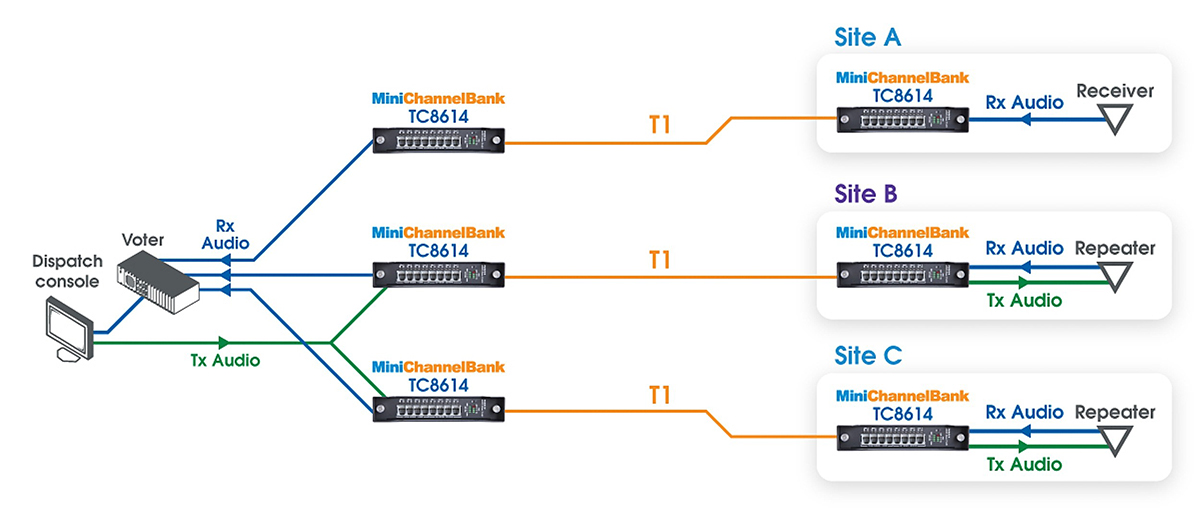
As part of the main solution, TC Communications provided the TC8614 Four-Wire E&M Analog & Dry Contact over T1/E1 Multiplexer to migrate the customer’s police radio system to T1. The network was extended over DS1 circuits spread tens of miles apart, which connected the transit police department to 10 remote sites.
Several months later, the customer installed additional TC8614 cards as part of a SCADA application after converting two RTNA two-wire lines to T1—but not before TC Communications resolved a mysterious connectivity issue caused by a third-party error that required a fast turnaround.
Finding a T1-Based Solution
The majority of the transportation authority’s radio network infrastructure consisted of FDDA (Four-Wire Dedicated Digital Access) and RTNA (Radio Tie Line) circuits, which were being taken out of service.
FDDA lines are a somewhat dated type of dedicated copper wire connection that have largely been displaced by fiber optic cables but may still be used where legacy systems are in place. On the other hand, RTNA lines are used extensively in public safety systems to manage operations for radio communication and emergency services.
As both types of lines were going to be retired, the customer approached Verizon to lease T1 lines to replace them. Working with a consulting firm specializing in wireless communications, the customer ordered standalone units of the TC8614 4W E&M Analog & Dry Contact over T1/E1 Multiplexer, part of the Mini Channel Bank family, for testing with the FDDA and RTNA lines.
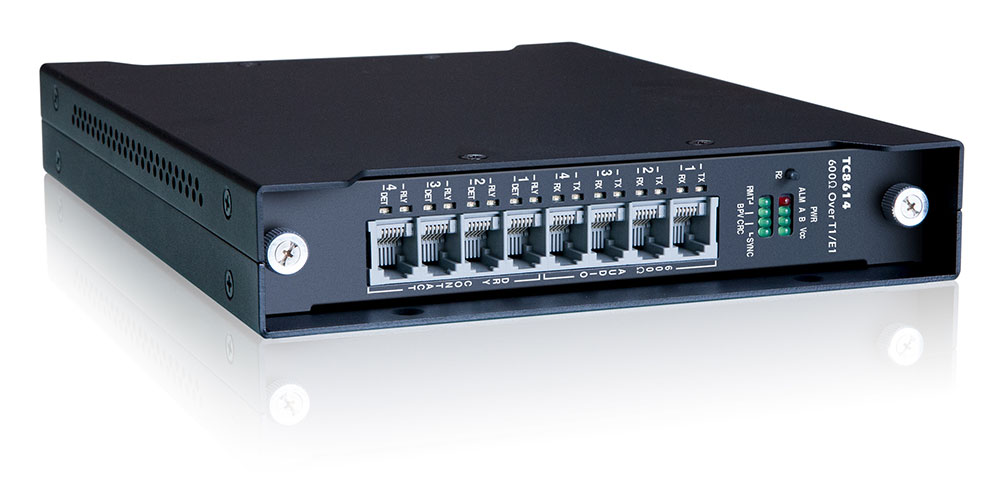
After providing on-site training, TC engineers and the contractor’s lead engineer successfully tested the TC8614 with the FDDA lines “without any glitches,” which led to a larger order of TC8614S standalone units to be used in the migration.
The Transit Police Radio Application
At the central site, the transit police department, the transportation authority’s contractor installed rack-mounted TC8614 cards to connect to a radio console over four-wire analog lines. To connect radio equipment at the 10 remote sites, the contractor installed one standalone TC8614S unit at each site, connecting to the radio equipment over four-wire from the front panel, and to the T1 line and the central site from the rear panel.
An overview diagram can be found below:
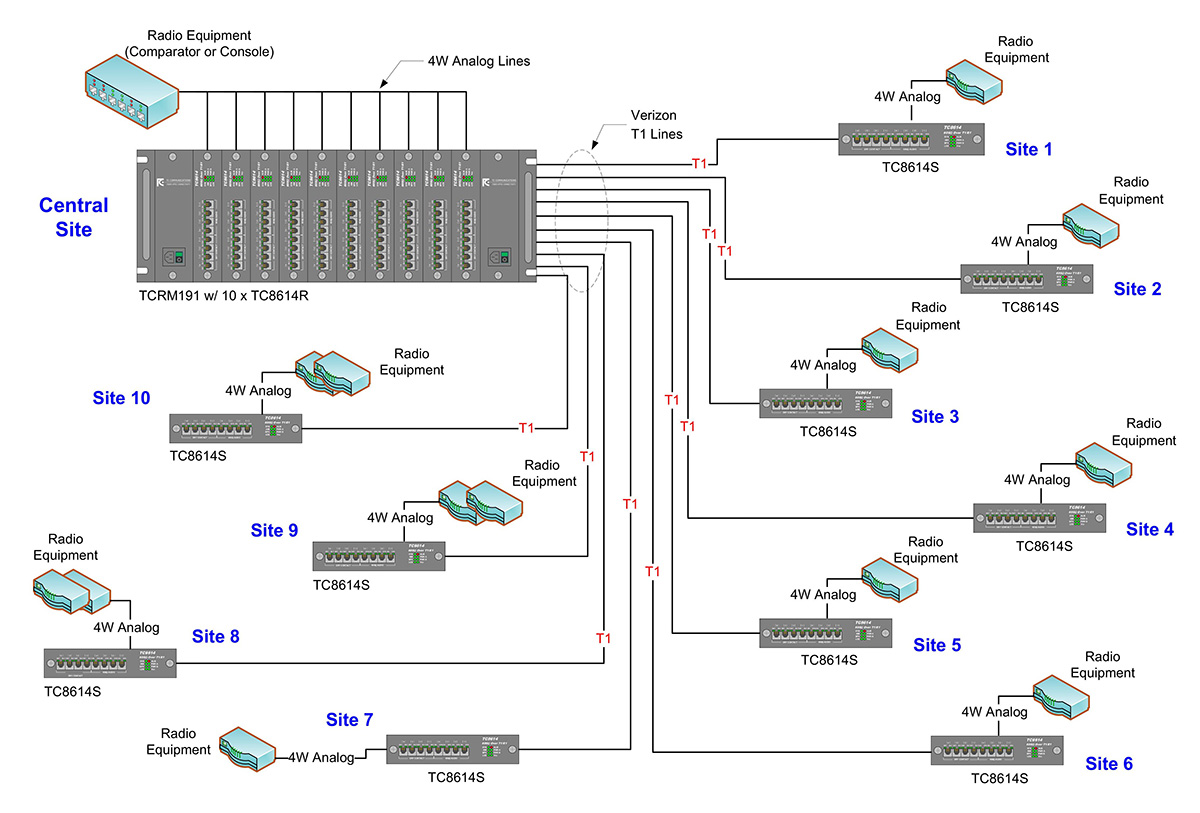
Within a few months, all 10 four-wire DS1 circuits had been successfully completed with TC8614 cards at each end, and all the connected police radio equipment was communicating effectively. Satisfied with the results, the customer said it had plans to order more in the future.
A Late-Stage Resolution
The following year, the customer ordered two additional T1 lines from Verizon to replace two RTNA lines and connect SCADA circuits at two substation sites in the network.
After purchasing and installing four new TC8614 cards for this application, the customer reported that the SCADA equipment was failing to connect properly. However, after conducting end-to-end testing on the T1 lines in question, Verizon found no connectivity issues with the circuits themselves. The RTNA lines were also being permanently retired in a few weeks.
Once the CPE converter boxes on either end were also ruled out, TC engineers determined that unlike the analog radio circuits, which were four-wire, both SCADA circuits required twowire connections. With no time to waste, TC engineers quickly reconfigured the TC8614 cards to meet the customer’s SCADA requirements for two-wire analog, bidirectional communication between RTUs, and the production team sent them out for overnight shipping.
Just in Time
One week later, the connectivity issue was fully resolved.
“We installed the TC8614 modems today, and everything is performing as it should,” the project engineer said. “Thank you so much for the quick turnaround!”
Verizon’s project manager also added, “Thanks for your amazing support!”
When problems arise during testing or deployment, the team at TC Communications works proactively to solve them. Even if the error is not on TC Communications’ end, the company typically makes a good faith effort to resolve the issue. In other cases, TC technical support will escalate the issue so that TC teams can resolve it in as timely a manner as possible.